Résidus d'antibiotiques dans la crevette : comment les analyses avant récolte préparent la crevette indienne à l'export
CERTIFICATIONS · 01 oct. 2026

For an importer, an antibiotic residue finding is one of the most expensive problems a shrimp shipment can have. A positive result at the border can mean a rejected consignment, the cost of returning or destroying it, and closer checks on future shipments from the same exporter.
The residue itself is created months earlier, at the pond, when a treatment is used that should not have been. That is why residue control in Indian shrimp starts on the farm and is checked again at every stage after it.
Which substances buyers worry about
Major import markets ban a group of antibiotics and pharmacologically active substances in food producing animals, including farmed shrimp. MPEDA’s pre harvest test screens for the two that matter most to shrimp exporters:
- chloramphenicol
- nitrofuran metabolites, tested as AOZ, AMOZ, AHD and SEM
Buyers’ own specifications and their importing country’s rules may cover a wider list, so the laboratory testing after processing usually goes further than the farm screen.
The table below shows how key import markets treat chloramphenicol and nitrofurans, the two substances the pre harvest test screens for.
| MARKET | RULE, ISSUED BY AND DATE | WHAT IT MEANS FOR CHLORAMPHENICOL AND NITROFURANS |
|---|---|---|
| European Union | Regulation (EU) 2019/1871, European Commission, as amended by Regulation (EU) 2023/411. Limits apply from 28 November 2022 | Reference points for action of 0.15 µg/kg for chloramphenicol and 0.5 µg/kg for each nitrofuran metabolite (AOZ, AMOZ, AHD and SEM). |
| États-Unis | 21 CFR 530.41 and FDA import alerts for nitrofurans and chloramphenicol, US Food and Drug Administration (checked 12 November 2026) | Both are prohibited from extralabel use in food producing animals, including shrimp. Shipments from firms on the import alerts can be detained without physical examination. |
| Japon | Positive List System under the Food Sanitation Act, Ministry of Health, Labour and Welfare. In force from 29 May 2006 | Chloramphenicol and nitrofurans are on the list of substances that must not be detected in any food. |
| Chine | National standard GB 31650, issued 6 September 2019 and in force from 1 April 2020, with Announcement No. 250 (2019) of the Ministry of Agriculture and Rural Affairs | Chloramphenicol and nitrofurans are on the list of drugs banned for use in food producing animals. |
Limits and lists are revised from time to time, so check the current rule for your market before you buy.
What MPEDA’s pre harvest test is
The pre harvest test (PHT) checks shrimp from a pond before it is harvested. MPEDA runs a network of 16 ELISA screening laboratories across the coastal states for this purpose and issues a certificate when a sample is clear.
PHT became a requirement for all export aquaculture products in April 2009. Since June 2014, MPEDA has required it only for raw material meant for export to EU countries, though many exporters and buyers still expect it for other markets.
To request a PHT, the farm must be enrolled with MPEDA. Enrolment involves a site visit, GPS mapping of the farm and records of inputs, production and sales, so each test result is tied to a known farm.
MPEDA’s SHAPHARI certification builds on this. SHAPHARI certifies hatcheries for antibiotic free seed and farms for good aquaculture practices. A farm that completes two consecutive negative pre harvest tests can add SHAPHARI Plus, which verifies the absence of specific banned antibiotic residues.
Why one test is not enough
A single test at one point can miss a problem that enters later or sits in a different pond. Exporters with a strong record test at more than one stage and keep the results linked to the farm of origin. If a lot fails, they can find the pond it came from, and if a pond fails, its shrimp never reach a carton.
Prevention at the farm matters just as much. Farmers reach for medicine when shrimp look sick. If the right products are not available, or nobody explains withdrawal periods and dosage, the risk of a residue rises. Responsible input supply and field guidance cut that risk at the source.
How Olpad Aqua controls residues
Our approach starts with the inputs. Through four coastal outlets at Olpad, Surat, Navsari and Valsad, we supply more than 30 types of certified medicine to the farmers in our network and guide their responsible use. A single wrong treatment months earlier is what fails a test at the buyer’s port, so the guidance matters as much as the product.
We then run three stages of quality control:
- QC1 at the farm. Pre harvest testing and grading at the pond by more than 20 QC supervisors, each with five or more years of experience. No pond is harvested before it passes.
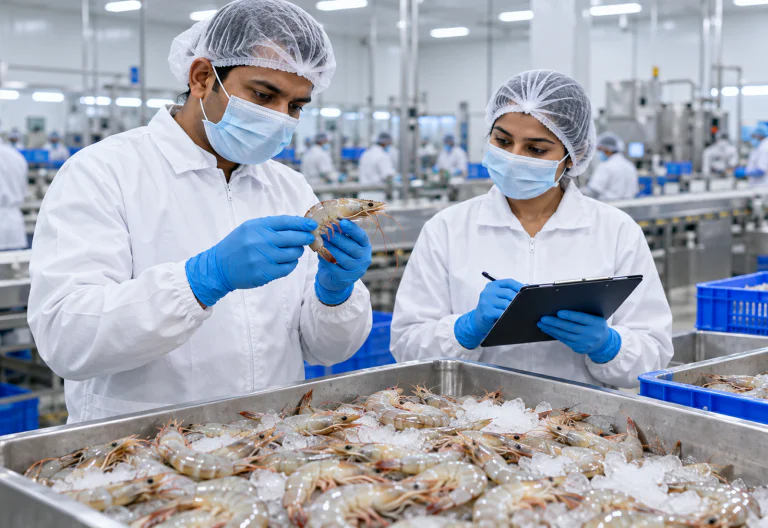
- QC2 at processing. Grading and hygiene control at our partnered certified facilities at Taloja, supervised by our own QC team inside the facilities.
- QC3 in the laboratory. Antibiotic, microbial and chemical testing, with traceability recorded back to the farm of origin.
Because we supply the seed, the inputs and the guidance through the crop, every batch we ship can be traced back to its farm of origin.
What to ask your shrimp supplier
Whoever you buy from, these questions will tell you how seriously residues are managed:
- Is every pond tested before harvest, and can I see the results for my lot?
- Which laboratory tests the finished product, and which substances does it test for?
- Can each lot be traced back to the farm and pond of origin?
- Who supplies medicine to the farms, and how is its use guided and recorded?
- What happens to a pond or a lot that fails?
Ask for the documents behind each answer. Test certificates, lab reports and lot codes should be ready to share before you sign a contract.
À lire aussi
Questions fréquentes
A pre harvest test checks shrimp from a pond for banned antibiotic residues before the pond is harvested. MPEDA’s PHT screens for chloramphenicol and nitrofuran metabolites (AOZ, AMOZ, AHD and SEM).
MPEDA has required the pre harvest test for raw material meant for export to EU countries since June 2014. Many exporters, including Olpad Aqua, test every pond before harvest regardless of the destination.
Import markets ban several antibiotics in farmed shrimp. Chloramphenicol and nitrofurans are the substances MPEDA’s pre harvest test screens for, and buyers’ specifications often list more.


Dernières actualités et analyses

-
CERTIFICATIONS · 08 oct. 2026
Certifications à l'export des produits de la mer en Inde : HACCP, BRCGS, FDA, agrément UE et EIC
Lire la suite