How to import shrimp from India: a step by step guide for buyers
EXPORT MARKETS · 17 Sep 2026

India exported 792,647 tonnes of frozen shrimp in FY 2025/26, according to MPEDA, to buyers in the US, China, the EU, Southeast Asia, Japan, the Middle East and beyond. When a first order goes wrong, the cause is often avoidable: a loose specification, a plant that is not approved for the destination market, or documents that are not ready when the container lands.
Step 1: Write a clear specification
A supplier can only quote accurately against a full specification. At minimum, it should state:
- species (Vannamei or Black Tiger)
- product form (HOSO, HLSO, PUD, PD, PDTO, cooked or a custom cut)
- count and the unit it is measured in (per pound or per kilogram)
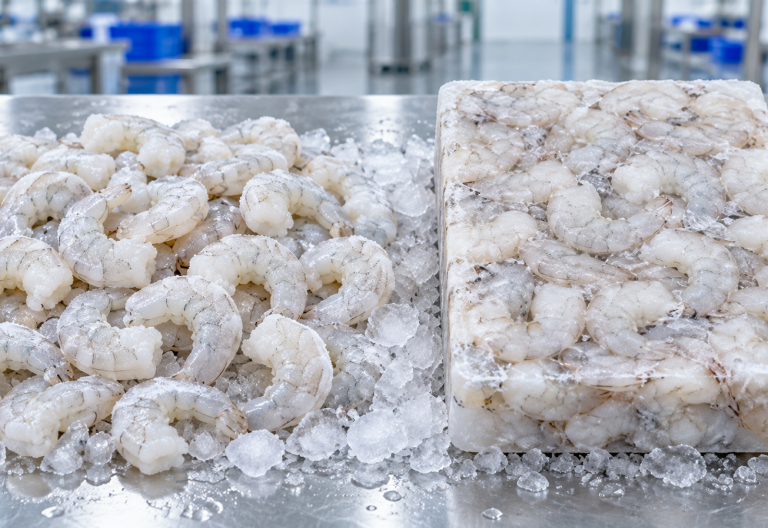
- freezing format (IQF or block frozen) and the glaze allowed
- packing (inner pack size, master carton, labelling, private label artwork)
- volume per shipment and how often you will order
- destination port and delivery terms
Add any market specific requirements, such as additive limits, residue testing or labelling rules for your country. If you are not sure which format suits your product, describe the end use and ask the supplier to recommend one.
Step 2: Check the supplier and the processing plant
Approval to sell into most markets belongs to the processing plant, not to the trading company. Ask which facility will process your order and check it against your market’s requirements.
- European Union. The plant must appear on the EU’s list of approved establishments for India. After a round of approvals in September 2025, India had 604 EU approved seafood units (MPEDA, 11 September 2025).
- United States. The plant must be registered with the FDA and operate a seafood HACCP plan.
- China. Overseas food plants exporting to China must be registered with China’s customs authority.
- Other markets. Ask for the plant’s registrations and the certificates your buyers expect, such as HACCP, BRCGS or ISO.
Ask for copies of each certificate with its scope and expiry date, and arrange an audit or a video walkthrough of the line if you cannot visit.
Step 3: Agree price, terms and payment
Prices for Indian shrimp are usually quoted per kilogram or per pound of net weight, FOB an Indian port or CFR or CIF your port. Make sure the quote states the Incoterm, the net weight basis and the glaze.
Payment terms vary by relationship. New buyers often start with a letter of credit or a part advance, while established buyers may move to documents against payment. Write the agreed quality tolerances into the contract, including count, uniformity, glaze and the right to reject on arrival.
Step 4: Pre shipment testing and inspection
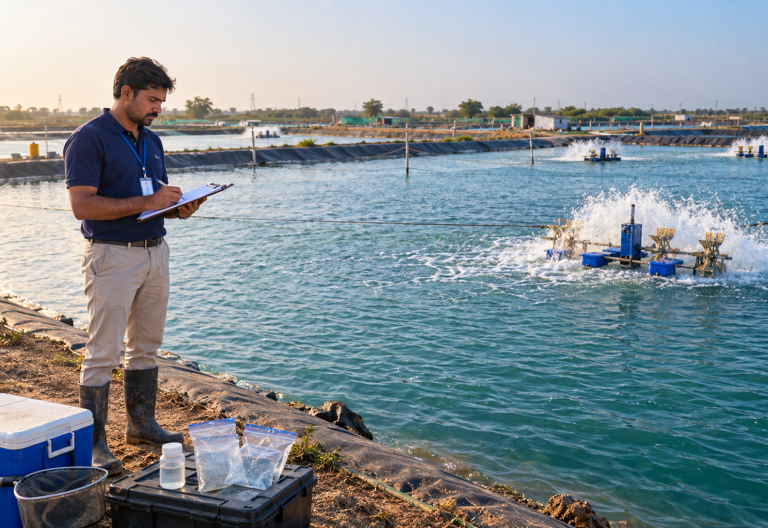
Before the shrimp is packed, a reliable supplier will have tested it more than once. Farmed shrimp for export should be checked for banned antibiotic residues before harvest and tested again in a laboratory after processing. Ask for the laboratory report for your lot along with the lot code, so you can match the results to the cartons you receive.
Step 5: Export documents
The usual document set for an Indian shrimp shipment includes:
- commercial invoice
- packing list
- bill of lading
- certificate of origin, issued through India’s online certificate of origin system
- health certificate, issued under the Export Inspection Council of India for markets that require one, including the EU
- laboratory analysis reports
- any importer specific documents, such as private label approvals
Your market may require more. Confirm the full list with your customs broker before the first shipment and share it with your supplier.
Step 6: Shipping and the cold chain
Frozen shrimp travels in refrigerated containers set to minus 18 degrees Celsius or colder. Ask your supplier how the product moves from the cold store to the port, how temperature is monitored on that leg, and how long the container will wait before loading. Short road legs and recorded temperatures reduce the risk of a thaw that you only discover when the cartons are opened.
Step 7: Arrival, clearance and duties
At the destination, your customs broker files the entry and the authorities may inspect or sample the consignment. Each market has its own rules.
For the US, buyers handle FDA prior notice and pay the applicable duties. Indian shrimp entering the US is subject to antidumping and countervailing duties, with rates that differ by exporter and are revised in annual reviews. A reciprocal tariff applies on top of those. Tariffs on Indian goods reached a combined 50 percent in August 2025 (White House executive order, 6 August 2025), and the trade deal the US confirmed on 6 February 2026 brought the rate down to an 18 percent reciprocal tariff (United States and India joint statement, 6 February 2026). On 20 February 2026 the US Supreme Court ruled that the President did not have authority to impose the reciprocal tariffs under the International Emergency Economic Powers Act, so that rate no longer applies (Supreme Court of the United States, Learning Resources, Inc. v. Trump, 20 February 2026). Confirm the current rates for your supplier with your broker before you agree a price.
For the EU, consignments enter through a border control post, where documents are checked and some
shipments are inspected and sampled.
How Olpad Aqua handles an export order
We are an integrated shrimp company based at Olpad in Surat district, Gujarat, and we export to the USA, the European Union, Japan, China, the Middle East, Vietnam and Canada.
Our farmer network of more than 800 farmers stocks certified seed from CAA approved hatcheries. Every pond goes through pre harvest testing and grading before harvest, and every lot goes through laboratory testing for antibiotic, microbial and chemical residues after processing. Processing takes place at our partnered certified facilities at Taloja, which hold HACCP, BRCGS and ISO certification and are FDA registered, EU approved and EIC certified for export. They sit about 40 km from Nhava Sheva, and our 21 temperature controlled trucks, GPS tracked with real time monitoring, cover the road leg.
Our export team prepares the health certification, inspection and shipping documents before loading. We welcome buyer audits, third party audits and live video walkthroughs of the line.
Send us the species, count, cut, packing, volume and destination port, and we will send you a price.
Related reading
Frequently asked questions
A typical shipment carries a commercial invoice, packing list, bill of lading, certificate of origin, health certificate where required and laboratory reports. Your own market may require more, so confirm the list with your customs broker.
Many markets, including the EU, require an official health certificate. In India these are issued under the Export Inspection Council of India.
Species, product form, count, freezing format, packing, volume and destination port. With those details an exporter can give you an accurate price.


Explore Latest News & Insights

-
EXPORT MARKETS · 15 Oct 2026
Shrimp traceability from pond to port: what buyers should ask for
Read Update -
EXPORT MARKETS · 10 Sep 2026
IQF vs block frozen shrimp: which format suits your business
Read Update

